


A thousand-year-old story in wool — and the strangest year in its long life
Bonjour mes amis!
Something rather remarkable is happening this autumn. For the first time in roughly nine hundred and fifty years, the Bayeux Tapestry is in London. It has left Bayeux, and it is the most talked-about object in Europe at the moment. So we thought you might enjoy the whole story: what it is and how it came to travel. And why it is coming home to a museum grander than the one it left.
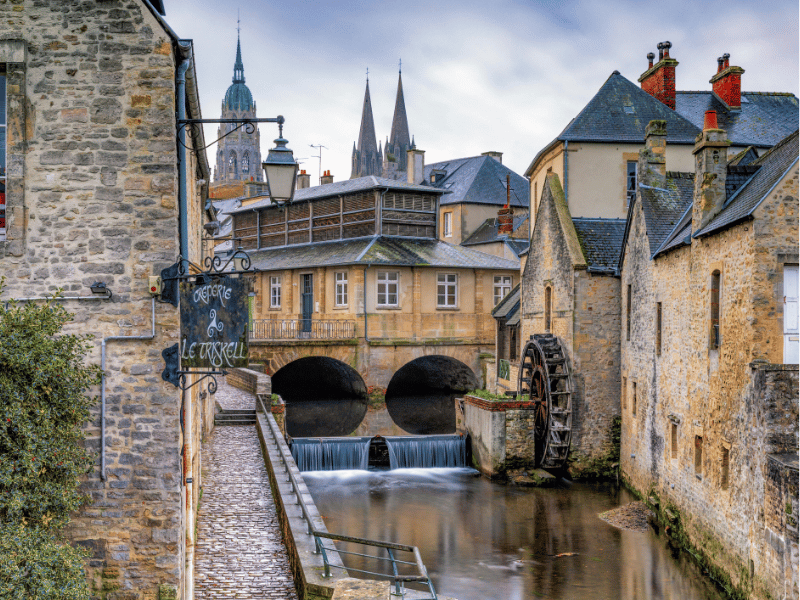
One practical note before the story, since a few of you have asked. The Bayeux Tapestry is in London this season. But that shouldn’t dim your excitement about an already planned trip to Normandy. But everything else is exactly where it has always been. The beaches, the cathedral it was made for, Mont-Saint-Michel, Honfleur, the cider and the Camembert. In fact, the town of Bayeux is quieter and lovelier for the pause.

Why the Bayeux Tapestry Is in London Right Now
The museum needed rebuilding.
The Bayeux Tapestry Museum closed its doors to the public on the 31st of August 2025 for a €38 million renovation and extension, designed by the British architecture practice RSHP. It reopens in October 2027, timed to the thousandth anniversary of William the Conqueror’s birth. The new building will show it on a single inclined table running its full seventy meters. No more curving around a darkened corridor.
And the tapestry had to go somewhere.
On the 8th of July 2025, during French President Macron’s state visit to Britain, the two governments announced it would spend the closure at the British Museum. In exchange, treasures representing all four nations of the United Kingdom — including material from Sutton Hoo and the Lewis chessmen — travel to museums in Normandy.
The key dates, in order:
| Date | What happens |
| 31 August 2025 | The Bayeux Museum closes for two years of work. |
| 19 September 2025 | Conservators remove the tapestry from its case and place it in secure storage a few steps from Bayeux Cathedral. |
| 9–10 July 2026 | It leaves Normandy after dark in a double crate built to hold a constant 20°C and absorb vibration. Then it crosses by the Channel Tunnel and reaches the British Museum around three in the morning. |
| 10 Sept 2026 – 11 July 2027 | On public display in the Sainsbury Exhibitions Gallery (Room 30), by timed ticket only, indemnified by the British government for around £800 million. |
| October 2027 | The new Bayeux museum opens, with restoration work expected to begin from 2028. |
Is It Loaned Often? Almost Never
This is the part most travelers do not realize. In roughly a thousand years, it has left Bayeux exactly twice — both times to Paris, both under duress. Napoleon had it brought to the Louvre in 1803–04 as propaganda for an invasion of Britain that never came, and the Germans moved it to the Louvre basement in June 1944. That is the entire travel history, and it has never crossed the Channel before.
Britain asked twice before, and France said no both times — for the Queen’s coronation in 1953, and for the 900th anniversary of Hastings in 1966 — on conservation grounds. Macron proposed it again in 2018, and the condition of the textile put the idea on hold for years.
It has outlived a revolution, an emperor, and the SS. Nine centuries later, it took a tunnel under the sea in a crate held at a steady twenty degrees.
You can see why the caution. A condition survey counted the marks of a thousand years: stains, creases, small gaps and tears in the linen, all carefully mapped before anyone moved it. Not everyone in France was happy about the loan, and a petition gathered signatures. But Bayeux’s mayor made the argument that carried the day: the museum was closing regardless, so the real choice was not London or Bayeux, but London or a crate in storage. Better, he thought, that people get to see it.
Seeing the Bayeux Tapestry in London is worth a detour if you happen to be routing through anyway. Demand has been enormous, with some 80,000 people joining the queue for the first ticket release. Further dates open on the 21st of October 2026, and the spring and summer 2027 dates follow early next year. In London it is laid flat for the first time in its history. You look down onto the stitching rather than along a wall. And if London is not on your itinerary, do not fret: it comes home in 2027. We rather think Bayeux is the better place to meet it anyway.


First Things First: It Is Not a Tapestry
A tapestry is woven — colored threads worked into the fabric on a loom, so picture and cloth are one thing. The Bayeux Tapestry is nothing of the sort. The linen was woven plain first, and only afterwards did embroiderers stitch the story onto its surface in colored wool. It is a broderie — an embroidery. Scholars have grumbled about the name for two centuries and lost the argument entirely.
It runs about 68.4 meters (224 feet) long and just 50 centimeters (20 inches) high. Embroiderers worked nine linen panels separately, then joined them. That tells us this was professional workshop production, not a domestic project. They used roughly ten shades of wool, dyed with madder, woad and weld, and left the background entirely bare. That is precisely why the whole thing reads so clearly from a distance.
The Story It Tells
Fifty-eight scenes run left to right in one continuous strip, with short Latin captions above the action and borders full of griffins, hunting scenes and Aesop’s fables below. It covers roughly two years, from 1064 to the autumn of 1066.
It opens with Harold Godwinson, the most powerful nobleman in England, sailing to Normandy (scene 5), where he is shipwrecked and delivered to Duke William. Then comes the scene on which everything turns: Harold, hands on two reliquaries, swearing an oath (scene 23). What exactly he swore is the great unanswered question of the eleventh century, but the Normans were in no doubt — he had promised William the English crown.


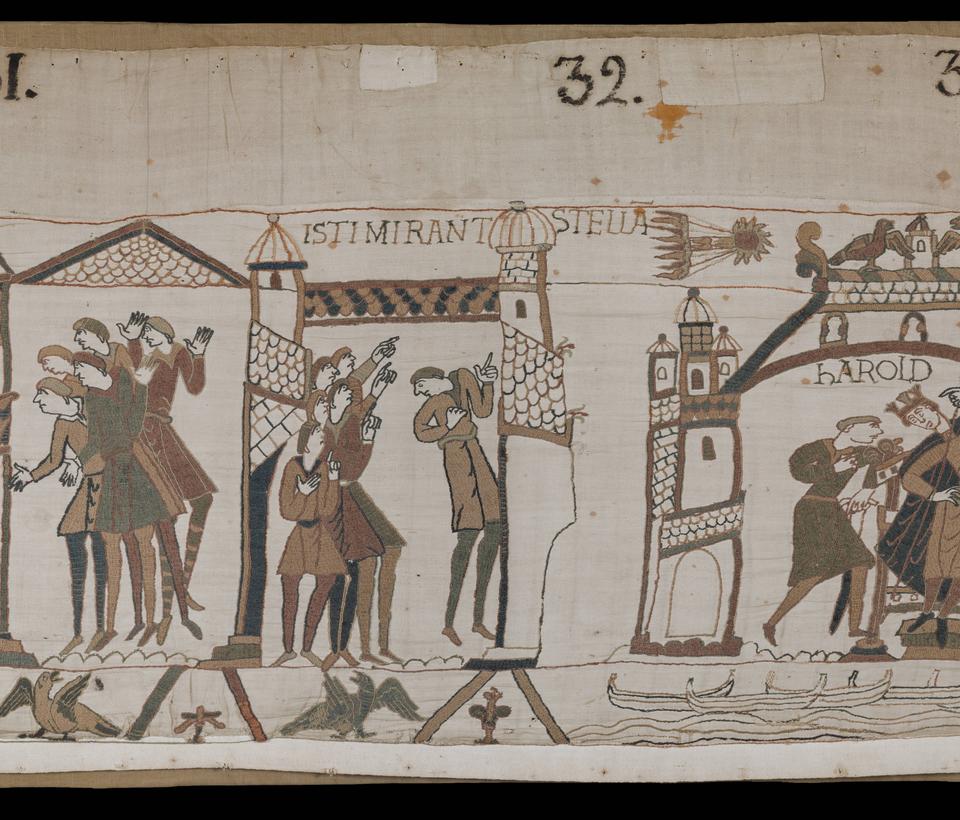
Edward the Confessor dies and Harold is crowned. Then a crowd of Englishmen point in alarm at a streak of fire overhead — Isti mirant stella, “these men marvel at the star.” It is Halley’s Comet, which passed over England in April 1066, and this is its first known depiction anywhere (scene 32). Beneath Harold’s throne, a ghostly fleet of empty ships waits in the border. The needlewomen knew how to foreshadow.
It is the closest thing the eleventh century has left us to a film reel — one story told in a single unbroken take, with cutaways in the margins
What follows is a shipbuilding montage, a Channel crossing with horses standing in the boats, and then Hastings, on the 14th of October 1066. Bishop Odo appears in the thick of it, rallying the young men with a club — a churchman was not supposed to shed blood. Harold dies, though whether the famous arrow-in-the-eye figure is really him is still argued over. Then the English flee, and the work simply stops. The final panel is missing — almost certainly William’s coronation at Westminster on Christmas Day.
Who Made It, and Where
We do not know — no document survives to tell us. But the consensus has firmed up, and it points somewhere that surprises most first-time visitors.
The patron was almost certainly Odo, Bishop of Bayeux — Earl of Kent and William’s maternal half-brother, who appears with a prominence difficult to explain any other way. The captions name three of his own retainers, men who appear nowhere else in the record. He most likely commissioned it for the consecration of his new cathedral at Bayeux in 1077, a ceremony William himself attended.
But it was made in England, not Normandy. Anglo-Saxon needlework — opus anglicanum — was the most admired in Europe, the designs draw closely on manuscript illumination from Canterbury, and the Latin spelling betrays English habits. Kent, where Odo held his earldom, is the likeliest home. So the work now “returning” to England may well have been made there in the first place.
In France it is still sometimes called la Tapisserie de la Reine Mathilde. The name comes from an old tradition that William’s wife and her ladies stitched it themselves. It is a charming picture with essentially no evidence behind it.

Nine Centuries of Narrow Escapes
For a fragile strip of linen and wool, its survival is improbable. The first written mention comes only in 1476, in an inventory of Bayeux Cathedral describing a long, narrow hanging displayed around the nave each July for the Feast of Relics. It had already been there four hundred years, unremarked.
Its closest call came in 1792, when revolutionaries requisitioned it as a cover for a military wagon; a local lawyer pulled it off the cart and handed it to the town authorities. During WWII the Ahnenerbe — the pseudo-scholarly branch of the SS — took an interest. They saw in the Normans’ Scandinavian ancestry a Germanic heritage worth claiming. They moved it to an abbey, then a château, then the Louvre. It came home, entered its present museum building in 1983, and joined UNESCO’s Memory of the World register in 2007.
What This Means for Your Trip
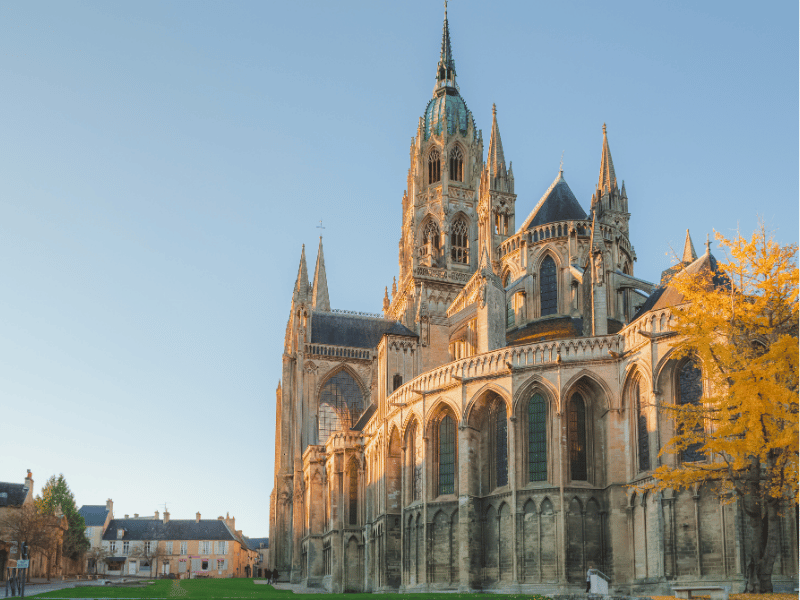
Honestly? This is a fine moment to be in Normandy. Some 400,000 people a year came to Bayeux for the tapestry. With them elsewhere for a season, the town feels as it must have a generation ago. Cafés with tables free at noon. The cathedral quiet enough to hear your own footsteps. That cathedral, remember, is the very building the tapestry was made for, and it is open. The beaches are ten kilometers away. Mont-Saint-Michel still rises out of its bay.
Our small-group Normandy tour spends five nights in the heart of Bayeux, with the beaches, Mont-Saint-Michel, Honfleur and Rouen within reach. We cap groups at eighteen travelers, which keeps the pace human — long lunches included.
À bientôt, mes amis — and if you do make it to Room 30 in London, look for the comet. It is easy to miss and impossible to forget.
Julia
If you prefer not to drive, small group tours provide a stress-free way to see all the highlights. The best part is that you don’t need to plan anything or do any research. On our 7-Day Normandy Tour, you will visit key sites, enjoy cultural experiences, and taste local cuisine while we take care of all the logistics. Traveling with a small group also means you are not alone on your journey. You will meet like-minded travelers who share your interests, creating opportunities to bond, share stories, and make new friends along the way.