On a June morning, Omaha Beach looks like any other beach in Normandy.
The tide is far out, the sand is pale and firm, and there are people walking dogs. Children are digging. Somebody is flying a kite. Nothing about it matches the photographs, and it is entirely normal to stand there for a moment wondering whether you have come to the right place.
Then you turn around.
Behind you is the bluff. It rises about a hundred and thirty feet, green and steep and entirely without cover, and from the water’s edge you can see exactly how far a man would have had to run, and exactly who was looking down at him while he ran. That is the moment. It comes from the land, not the sea. Your guide will have been telling you about that bluff for ten minutes before you reach the water — but it is standing underneath it that makes the words mean something.
The five beaches are strung along fifty miles of this coast, and they are not interchangeable. What happened at Utah bears almost no resemblance to what happened at Omaha, seven miles east. Gold, Juno and Sword each had their own morning.
Here is what happened at each of them, and what is left of it now.

What Operation Overlord actually was
On June 6th, 1944, the Allies landed along fifty miles of Norman coastline in what remains the largest seaborne invasion ever attempted. Around 156,000 troops came ashore or dropped from the sky that day, carried by a fleet of nearly 7,000 vessels of every size.
They came here, and not to the Pas-de-Calais, precisely because the Pas-de-Calais made more sense. The crossing there is far shorter, the German command expected it, and an enormous Allied deception effort spent months making sure they went on expecting it. Normandy was farther, harder, and unfortified by comparison. That was the point.
The invasion was meant for June 5th. The weather in the Channel turned foul, and General Eisenhower postponed by a day on the strength of a narrow forecast of clearing skies — a decision made in a house in southern England by a man who had already written, and put in his pocket, a statement taking full blame if it failed.
The coast was divided into five sectors, running west to east: Utah and Omaha, assigned to the Americans; Gold and Sword, to the British; and Juno, between them, to the Canadians.
The night before: the airborne landings
The beaches were not the beginning. Hours before the first landing craft dropped its ramp, aircraft were crossing this coast in the dark.
In the west, roughly 13,000 American paratroopers of the 82nd and 101st Airborne Divisions jumped inland from Utah, tasked with seizing the causeways and crossroads behind the beach so the seaborne troops would not be trapped on the sand. Cloud and anti-aircraft fire scattered them badly. Men landed miles from where they should have been, alone, in hedgerows and flooded fields, and spent the night assembling into improvised units with whoever they found.
The scattering was chaos. It was also, by accident, effective — German commanders receiving reports of American paratroopers in dozens of separate places could not work out where the real attack was.
Sainte-Mère-Église is the village most associated with that night, and it is on our itinerary for a reason. Fighting reached its square in the early hours, and a paratrooper named John Steele caught his canopy on the church tower and hung there through it. A parachute still hangs from the steeple today. The village considers itself the first in France to be liberated, and the Airborne Museum beside the square is one of the finest small museums in Normandy.
At the eastern end of the invasion coast, the British 6th Airborne Division had its own night’s work — which brings us, eventually, to a small bridge over a canal. I will come back to it.


Utah Beach — the westernmost landing
Utah lies on the eastern shore of the Cotentin Peninsula, and of the five beaches it is the one that went most nearly to plan — though not at all in the way it was planned.
The landing was made by the 4th Infantry Division. Strong currents and lost control craft carried the first wave roughly 2,000 yards southeast of the intended position, onto a stretch of shore that turned out to be far more lightly defended than the one they had trained for.
The senior officer on that sand was Brigadier General Theodore Roosevelt Jr. He was fifty-six years old, walked with a cane, had a heart condition he had concealed, and had requested permission to land with the first wave three times before it was granted. He was the only general to go in with the leading troops. Recognizing the error and deciding immediately against correcting it, he is said to have told his officers that they would start the war from right there.
He was awarded the Medal of Honor. He died of a heart attack in Normandy five weeks later, on July 12th, and he is buried at Colleville-sur-Mer beside his brother Quentin, a pilot killed in the First World War.
Casualties at Utah were the lightest of the five beaches — somewhere around two hundred. The division pushed inland, linked with the scattered airborne, and turned north toward the port of Cherbourg.
What is there now: a wide, quiet, wind-scoured beach with dunes and a good museum built into a former German strongpoint, looking straight out at the water the landing craft came from.
Prefer not to drive?
Take our 7-Day Small-Group Tour of Normandy!


Omaha Beach — the hard one
Everything that could go wrong at Utah went wrong at Omaha instead.
The beach is a crescent about four miles long, and it is overlooked along its entire length by bluffs a hundred to a hundred and sixty feet high. Only five narrow draws cut through them — small valleys where a road could climb — and every one was covered by German positions. To leave the beach at all, you had to go through one of those five gaps.
The Allies also believed the sector was held by a second-rate static division. In fact, the experienced 352nd Infantry Division had moved into the area, and Allied intelligence did not know it.
Then the plan came apart in sequence. The aerial bombardment, dropping through cloud and afraid of hitting the incoming boats, released late and put most of its bombs behind the bluffs. The naval barrage was too short to do what was needed. Most of the amphibious tanks meant to swim ashore and give covering fire were launched too far out in heavy seas and sank, many with their crews. Landing craft drifted off their marks. Companies came ashore in the wrong places, without armor, in front of intact defenses.
The men who landed in the first waves — the 1st Infantry Division, the “Big Red One,” and the 29th Infantry Division — came out of the ramps into water and open sand with the bluff in front of them. American casualties at Omaha on June 6th are usually put at somewhere between two and two and a half thousand, and for several hours the commanders offshore genuinely considered abandoning the beach.
It was not abandoned, and how it was saved is the part that is hardest to write about calmly. It was not saved by a plan. The plan was gone. It was saved by small groups of men, mostly junior, mostly improvising, deciding to climb the bluff between the draws rather than die on the sand — and by destroyers that steamed in so close to shore they were almost scraping the bottom, in order to fire directly at the German positions on the bluff.


The Bedford Boys
If you want one story that makes Omaha comprehensible, it is this one.
Company A of the 116th Infantry Regiment, 29th Division, was a National Guard unit drawn from Bedford, Virginia — a town of about 3,200 people. It landed in the first wave, in front of the Vierville draw, at the western end of the beach.
Nineteen men from Bedford were killed that morning, most of them in the first minutes. Three more from the town died later in the Normandy campaign. Proportionally, Bedford lost more of its sons on D-Day than any other community in America, and for a town that size the arithmetic is unbearable: the telegrams arrived together, at a drugstore with a teleprinter, and had to be carried out one by one.
The National D-Day Memorial is in Bedford now. But the beach where it happened is here, and standing at the western end of Omaha, looking up at that draw, is not the same as reading about it.
What is there now: the sand, the tide, and above it Les Braves — a tall steel sculpture by Anilore Banon, installed in 2004, standing directly on the beach. And above the eastern end, on the bluff itself, the cemetery.
Pointe du Hoc — the cliffs between the two American beaches
Between Utah and Omaha, a promontory pushes out into the sea with hundred-foot cliffs on three sides. German engineers had put a battery of heavy guns on top of it, positioned to fire on both American beaches at once. It had to be taken.
The task went to the 2nd Ranger Battalion, under Lieutenant Colonel James Earl Rudder — roughly 225 men, who came ashore beneath the cliffs and climbed them, under fire, using rope ladders fired from the boats and extension ladders borrowed from the London Fire Brigade.
They reached the top and found the gun emplacements empty. The guns had been moved inland and hidden in an orchard, unguarded. A small Ranger patrol went looking, found them, and destroyed them with thermite grenades.
They then held the position for two days against repeated counterattacks, waiting for a relief that was late because Omaha had gone so badly. Of the roughly 225 who started, something in the region of 90 were still fit to fight when relief arrived.
What is there now: the ground here has never been landscaped. It is still a field of enormous overlapping craters, with shattered concrete bunkers you can walk into and cliffs you can stand at the edge of. It is the only place on this coast where the war is still legible in the earth itself, and it is the site most people talk about afterward. How far you walk into it is entirely up to you — there is a great deal to see from the paved paths near the entrance, and your guide will tell you what lies further out before you decide. In 1984, President Reagan gave a speech here, on the fortieth anniversary, with a number of the surviving Rangers sitting in front of him.


Gold Beach — the British landing and the harbour they brought with them
East of Omaha, the British 50th (Northumbrian) Infantry Division came ashore at Gold. The fighting was hard in places, particularly around the fortified seafront villages, but the division got off the beach and drove inland fast — far enough to cut the road to Bayeux, which fell the following day.
The only Victoria Cross awarded for actions on D-Day itself went to a company sergeant major of the Green Howards, Stanley Hollis, who cleared two German pillboxes on this sector.
But Gold is worth your attention for a different reason.
Arromanches and the Mulberry harbour
The Allies knew they could not capture a working deep-water port quickly — the Germans would destroy the facilities before surrendering one. So rather than capture a harbour, they built two in England, towed them across the Channel in pieces, and sank them into position off the Norman coast.
The one at Arromanches was called Mulberry B, or Port Winston. Something like 115 huge concrete caissons were sunk to form a breakwater, with floating roadways running to the shore, and through it passed the men, vehicles, and supplies that kept the invasion alive through the summer. Its twin, off Omaha, was destroyed by a great storm in mid-June.
You can still see it. The caissons are out there in the water off Arromanches, black shapes at high tide and enormous stranded concrete blocks at low, and from the cliff above the town you can make out the arc of the whole harbour. It is, for many travelers, the single most surprising thing on this coast — not a monument to what happened, but the actual object, still sitting in the sea eighty years later.
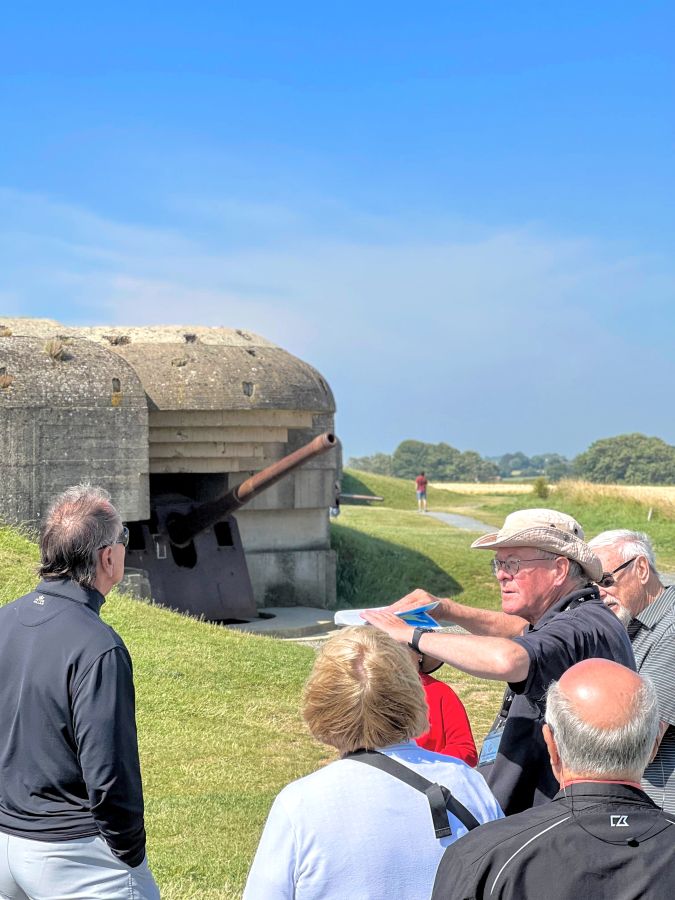
Just west, at Longues-sur-Mer, is the only German coastal battery in Normandy that still has its original guns in place.


Juno Beach — the Canadians
Between the two British sectors, the 3rd Canadian Infantry Division landed at Juno.
It deserves to be better known than it is. The Canadians came in against a defended seawall and a row of fortified seafront houses, and they took heavy losses in the first hour: around a thousand casualties that day, roughly 360 of them killed. Even so, by nightfall the Canadians had pushed farther inland than any other Allied force on any of the five beaches.
There is a particular weight to the Canadian contribution here. Canada was not invaded, not threatened, and not obliged. It sent an entire division onto this sand because it had decided the war was its own.
What is there now: the Juno Beach Centre at Courseulles-sur-Mer, opened in 2003 and staffed largely by young Canadians, which tells the story of Canada in the war rather than only the story of the beach. Inland at Bény-sur-Mer is the Canadian war cemetery, small and green and, unlike Colleville, almost always empty.
Sword Beach — the easternmost landing, and a bridge
Sword was the left flank of the whole invasion, taken by the British 3rd Infantry Division, with the objective of driving on Caen — a city that would not be fully taken until July.
Two things at this end of the coast matter more than the beach itself.
Pegasus Bridge
Just after midnight — before any landing craft had launched, before the first paratrooper jumped — six Horsa gliders were cast off over the Norman coast and came down in the dark beside two bridges over the Caen Canal and the River Orne. The lead glider stopped about a hundred and fifty feet from its objective, which remains one of the most extraordinary pieces of flying of the war.
The men inside, from the Oxfordshire and Buckinghamshire Light Infantry under Major John Howard, took the canal bridge in about ten minutes and held both against counterattack until relieved that afternoon by commandos marching up from Sword Beach.
Those commandos arrived to the sound of bagpipes. Their commander, Lord Lovat, had brought along his personal piper, a twenty-one-year-old Scot named Bill Millin, and ordered him to play — on the beach, and then along the road inland — even though regulations had forbidden pipers in combat since the First World War, because the pipes made them obvious targets. Millin played anyway. German prisoners said afterward that they had not shot at him because they assumed he had lost his mind.
This was the first Allied action of D-Day. The bridge was renamed Pegasus after the airborne shoulder patch, and the original span now sits in the grounds of the Mémorial Pegasus beside its replacement. The café at the bridge’s end claims to be the first house in France liberated, and has been run by the same family throughout.
The French who landed
Among the commandos who came ashore at Ouistreham that morning were 177 Frenchmen — the Kieffer commandos, under Commandant Philippe Kieffer, part of No. 4 Commando.
They were the only French troops to land on the beaches on June 6th. They came ashore in a country some of them had not set foot in for four years, and they took the fortified casino at Ouistreham.
Almost every French family along this coast has a liberation story, and they are still told at the table. My great-grandfather played the accordion. When his town was freed, he and his brothers took their instruments out into the street and played. My grandmother was a little girl then, and what she remembers is the American soldiers arriving, and the whole town celebrating together.


The cemeteries
You cannot understand this coast without them.
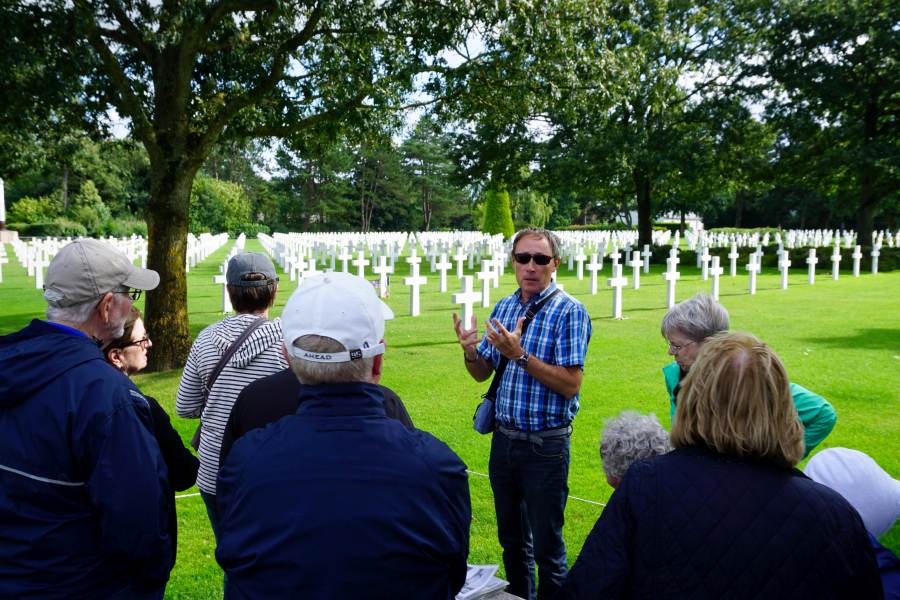
Our tours visit the Normandy American Cemetery at Colleville-sur-Mer, and we build real time into the day for it. The other two below are not on our itinerary, but if you are extending your trip or travelling independently, they are close by and I would not want you to leave without knowing they are there.
The Normandy American Cemetery, Colleville-sur-Mer
It stands on the bluff directly above Omaha Beach, on 172 acres that France granted to the United States in perpetuity. 9,388 Americans are buried there. A further 1,557 names are inscribed on the Walls of the Missing, in a garden at the eastern end, for men whose bodies were never identified or never found.
Among the graves are forty-five sets of brothers, thirty-three of them buried side by side. Two of the Niland brothers of New York are there. Theodore Roosevelt Jr. is there, beside Quentin. Four women are buried there. Three of the men buried there were awarded the Medal of Honor.
Every afternoon the flags come down and Taps is played, and the whole cemetery stops where it stands.
I will say one practical thing, because nobody tells people this: the visitor center is excellent and it is emotionally heavy, and it comes before the graves. Allow more time than you think. And if you are coming to find one particular name, tell us in advance, and tell the staff when you arrive — they will take you to the grave (the ABMC handles these requests, and it is worth writing ahead), and there are things they can do at the graveside that they will not do unless you ask.


Bayeux War Cemetery
The largest Commonwealth cemetery of the Second World War in France. It holds 4,144 Commonwealth burials, and more than 500 graves of other nationalities — most of them German.
That surprises almost everyone, so it is worth explaining. Commonwealth war cemeteries were laid out where the fighting happened, and they took in the dead recovered from those same fields — including the enemy. The German graves are maintained to exactly the same standard as the British ones, by the same gardeners.
Opposite the cemetery stands a memorial bearing over 1,800 names of the missing.
La Cambe German War Cemetery
Over 21,000 German dead lie at La Cambe, inland between Utah and Omaha. It is a very different place — dark stone crosses set flat in groups, a low grassy mound at the center, the whole thing heavy and inward and grey.
We do not take groups there, and I understand entirely why some visitors would rather not go. But if you have your own car and an hour to spare, I think it is worth the detour. Many of the men buried at La Cambe were seventeen and eighteen years old. Whatever you conclude standing among those stones, you will not conclude it lightly.
How to visit the beaches
How long you need. Three days is the realistic minimum to see the landing beaches without hurrying — one for the American sector, one for the British and Canadian sectors and Arromanches, one for the cemeteries and the airborne sites inland. Most travelers pair this with the rest of Normandy and take a week. If you are still working out the shape of your trip, we go through it properly in How Many Days Do You Need in Normandy?
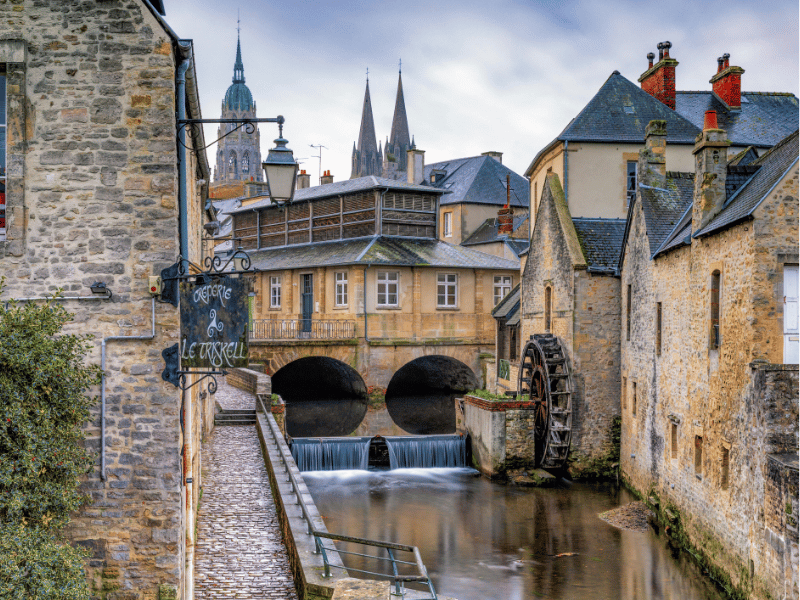
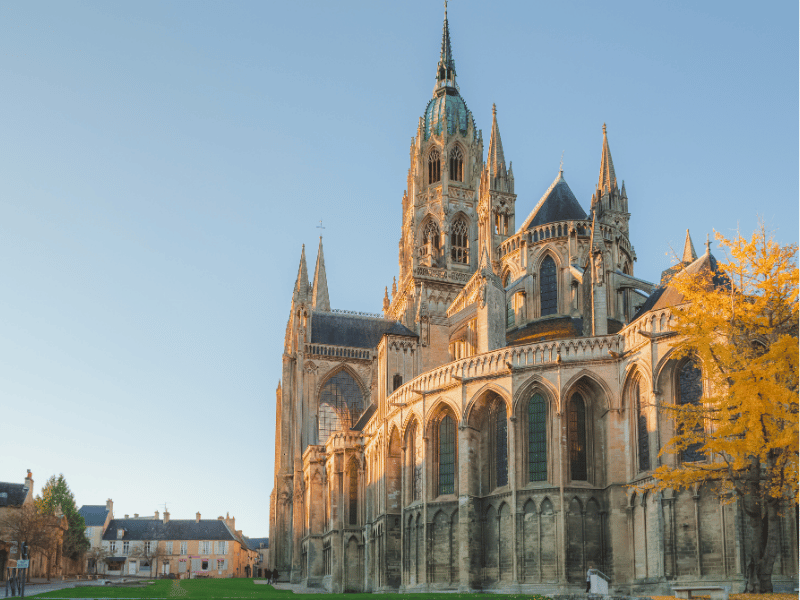
Where to base yourself. Bayeux, without much argument. It was liberated on June 7th, the day after the landings, and it came through the war essentially undamaged — which is why it still has its medieval streets and its cathedral. It is compact, it is walkable in the evening, and almost every site on this page is within twenty to forty minutes’ drive of it.
The walking. This matters, and vague answers help nobody. The cemeteries are flat, paved and fully accessible. Arromanches and the museums are easy. Omaha involves soft sand if you want to walk down to the water, and the bluff paths are steep. Pointe du Hoc is genuinely uneven: cratered ground, loose footing, some steps but there is a good deal you can see from the parking area there without crossing the rough ground. Thinking to join one of our Normandy tour designed specifically for active seniors? Visit our FAQ page for average age, group size and how much walking each day involves.
When to come. May, early June and September are the best weeks — long light, mild weather, and the coast at its greenest. Be aware that the days around June 6th are unlike any other time of year: ceremonies, veterans, parachute drops, closed roads, and hotels in Bayeux booked out a year or more ahead at prices to match. Anniversary years are more extreme still. It is extraordinary if that is what you have come for, and difficult if it is not.
Whether to take a guide. We sell guided tours, so weigh this accordingly. But the beaches do not explain themselves. Sand is sand, and a field is a field. What makes this coast overwhelming is understanding what you are looking at: which draw the men in front of you were trying to reach, which company came ashore where you are standing, why that particular bluff mattered and the next one did not.
You either arrive already knowing all of that, or someone has to tell you while you stand there. That is what a good guide does here, and it is the difference between seeing a beach and understanding one.


One last thing, from this side of the water
I would like to tell you something that Americans are usually surprised to hear.
Along this coast, in the villages behind these beaches, the American flag is not an unusual sight in June. It hangs from windows in Sainte-Mère-Église and Colleville and Vierville, in towns of a few hundred people, put out by families who were not born when any of this happened.
At the cemetery above Omaha, there are French families who have looked after individual graves for three generations — leaving flowers, writing to relatives in America, passing the name down to their children when they get old. Nobody organizes this. Nobody is thanked for it.
These stories are passed down here, from grandparents to parents to children, and they do not fade with the generations. Neither does the gratitude. We were thankful then, and we are still thankful now.
I still remember my first visit to the cemetery at Colleville. They taught us about the war in school, but none of it had prepared me for what it feels like to stand in front of those crosses and understand, all at once, how devastating it truly was — and how young the men were who ended it, and how brave. It is a moment I will carry for the rest of my life.
That is why we bring people here, and why we would rather do it slowly, in a small group, with time to stand still.
Ready to Visit Normandy?
Our 7-Day Normandy small group tour spends three days on the landing beaches, the American Cemetery at Colleville-sur-Mer, and the airborne sites at Sainte-Mère-Église, in groups of no more than eighteen. If you are travelling to find a relative’s grave or the place where a family member served, tell us when you book — we will build the time in. We’d be happy to answer any questions you have about the tour – send us a message!
À bientôt! Until soon, from the chalk cliffs and apple orchards of Normandy.
Keep Reading
Normandy Map and Guide – Must-See Places, Food, and Travel Tips