

Bonjour mes amis!
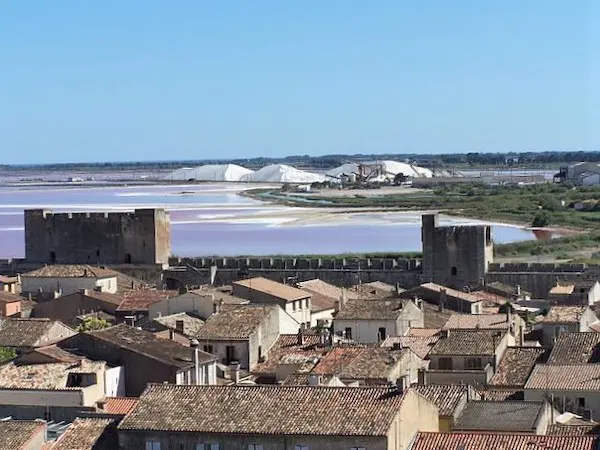
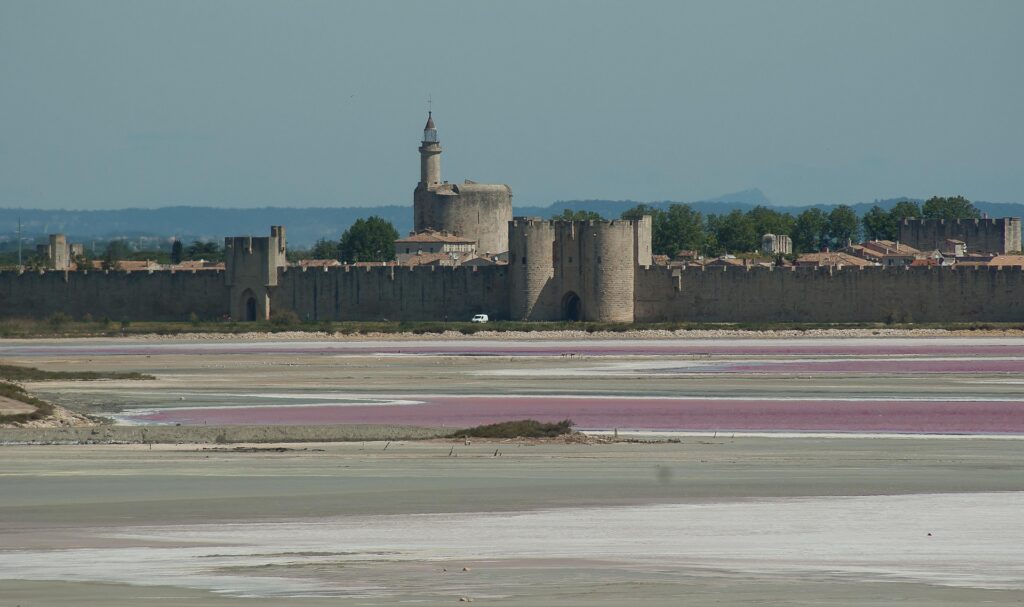
Aigues-Mortes rises from the flat, shimmering wetlands of the Petite Camargue, between Nîmes and Montpellier. Its golden ring of medieval walls stands out for miles across the marshes. Around it, salt pools glow pink in summer and flamingos wade in the lagoons.
Inside the ramparts, a grid of narrow streets leads to shaded squares and lively café terraces. King Louis IX founded the town in 1240, and its walls still stand complete today. For lovers of history, light and wide-open landscapes, it is a must-see.
Aigues-Mortes sits just next door to , our seaside base in the South of France. For that reason, it is the very first place we take our travelers. Here is everything you need to know before you visit.
Aigues-Mortes at a Glance
| Where | Gard, Occitanie, on the edge of the Camargue. About 4 miles (6 km) from the sea at Le Grau-du-Roi |
| Say it | “Egg-mort” |
| Meaning | From the Latin Aquae Mortuae (“dead waters”), for the still marshes all around |
| Founded | 1240, by King Louis IX (Saint Louis) |
| Famous for | A complete circuit of medieval ramparts, the Tower of Constance and pink salt marshes |
| Local treats | Sweet fougasse, Camargue fleur de sel and vin des sables (sand wine) |
| Time needed | Two hours for the old town. Half a day with the ramparts and the salt marshes |
| Walking | Flat and easy inside the walls. Stairs and uneven stone on the ramparts |
Why Aigues-Mortes Was Built in the Middle of a Marsh
In the 13th century, the kingdom of France had no port of its own on the Mediterranean. Provence belonged to the Holy Roman Empire, and Montpellier answered to the King of Aragon. As a result, a French king who wanted to sail east had to ask his neighbors for a harbor.
Louis IX refused to depend on anyone. In 1240, he obtained a strip of marshland from the monks of Psalmodi Abbey. It was a strange place to build. The land was empty, the water was brackish, and every stone had to be brought in. To attract settlers, the king granted a generous charter in 1246, with rare freedoms and tax breaks.
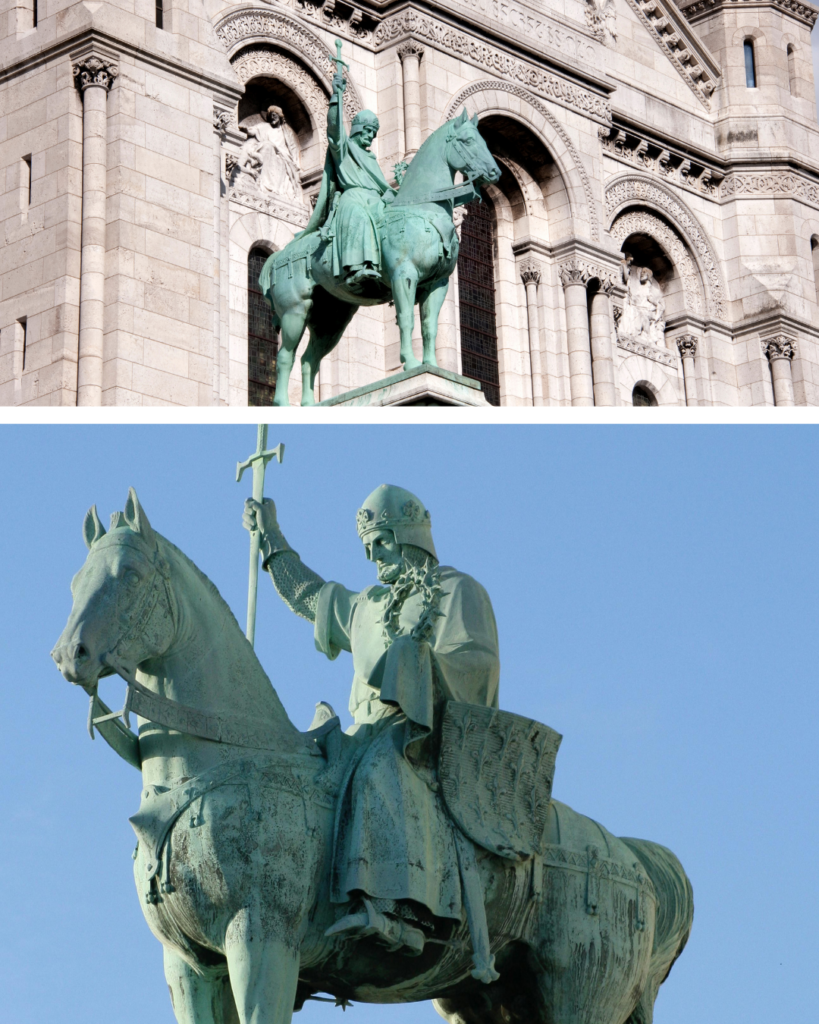
Two years later, in 1248, Louis sailed from Aigues-Mortes on the Seventh Crusade, bound for Egypt. He left again in 1270 on the Eighth Crusade and died that summer outside Tunis. The Church made him a saint in 1297, and he remains the only king of France ever canonized. He is the same king who built the Sainte-Chapelle in Paris to house his most treasured relic, the Crown of Thorns. It was consecrated in April 1248, just months before he sailed from Aigues-Mortes. That is why so many statues show him holding the crown. Today, the French simply call him Saint Louis.
Louis IX had to work with the land he could get, and it did not touch the open sea. Ships reached the town through a chain of lagoons and a channel dug toward the coast. Over time, sand and silt clogged that route. Then, in 1481, Provence became part of the kingdom of France. Marseille, a far more convenient harbor, became the kingdom’s main port on the Mediterranean.
Usually, a town that loses its purpose also loses its walls, as people carry off the stones to build elsewhere. Aigues-Mortes kept its ramparts. The salt marshes never stopped working and kept the town prosperous. The wind here can also be brutal, and the walls stopped sand from blowing into the streets. In fact, Saint Louis had wanted them partly for that reason.
A king needed a port, so he built one in the middle of a salt marsh.
Join us! Our South of France small-group tours
visit Aigues-Mortes.
The Ramparts of Aigues-Mortes: A Mile of Medieval Walls
Louis IX planned the ramparts but never saw them. Work began in 1272, two years after his death, under his son Philip III. It was finished around 1300 under his grandson, Philip the Fair.
The result is an almost perfect rectangle of stone, 1,640 meters around. That is just over a mile. The walls rise about 11 meters (36 feet) and are nearly 3 meters (10 feet) thick. Five large gates and five smaller ones open onto the streets inside.
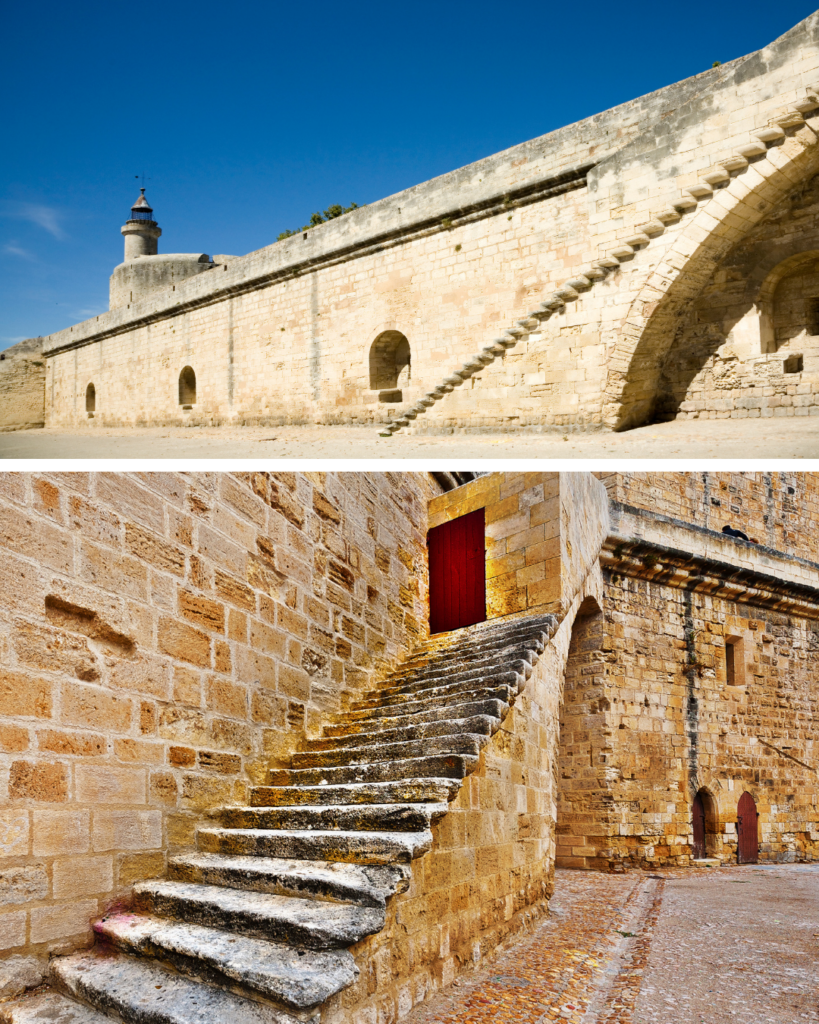
Above all, the ramparts are complete. You can walk the whole circuit along the top, which is rare in France. On one side, you look down on terracotta roofs and hidden gardens. On the other, the view stretches across marshes, canals and white hills of salt.
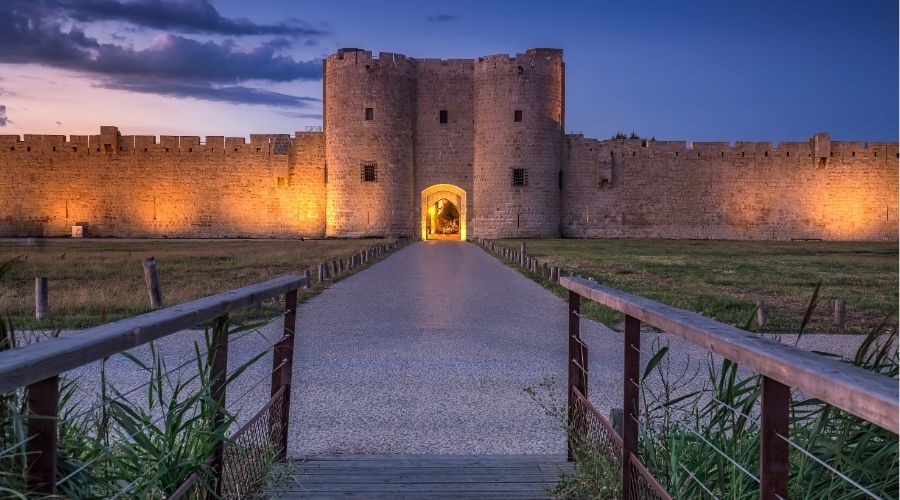
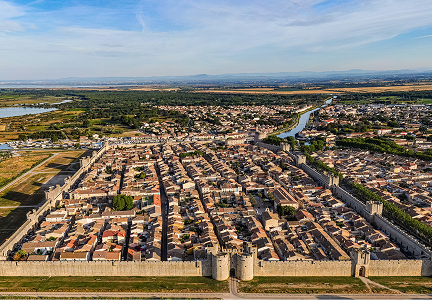
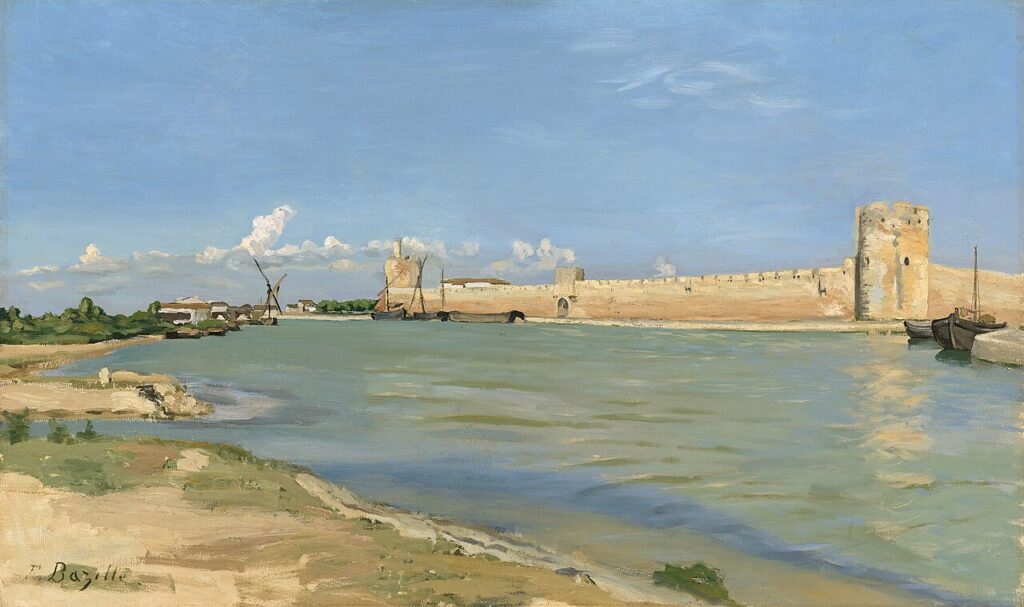
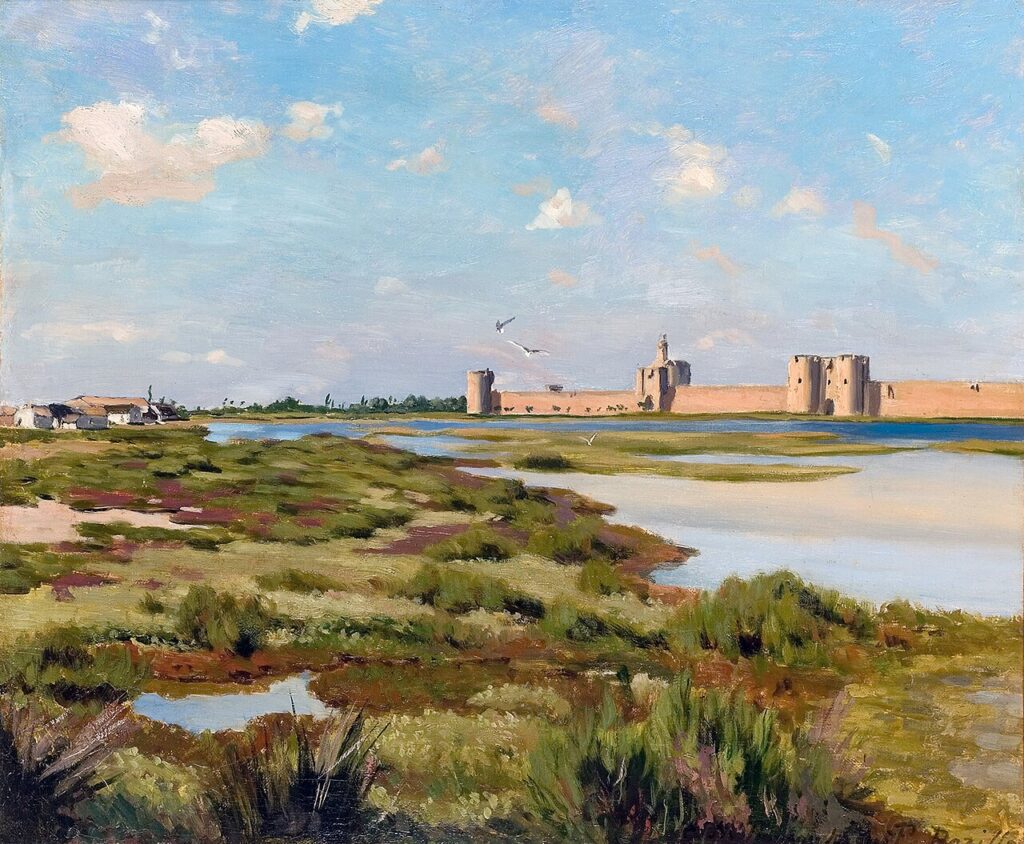
If you have seen Carcassonne, you will notice the difference at once. Carcassonne is a hilltop fortress crowned with turrets. Aigues-Mortes, by contrast, is low, flat and severe, a royal town drawn with a ruler. The Impressionist painter Frédéric Bazille loved that stark outline. He painted the walls in 1867, glowing above the lagoon.
The Tower of Constance: Fortress, Lighthouse and Prison
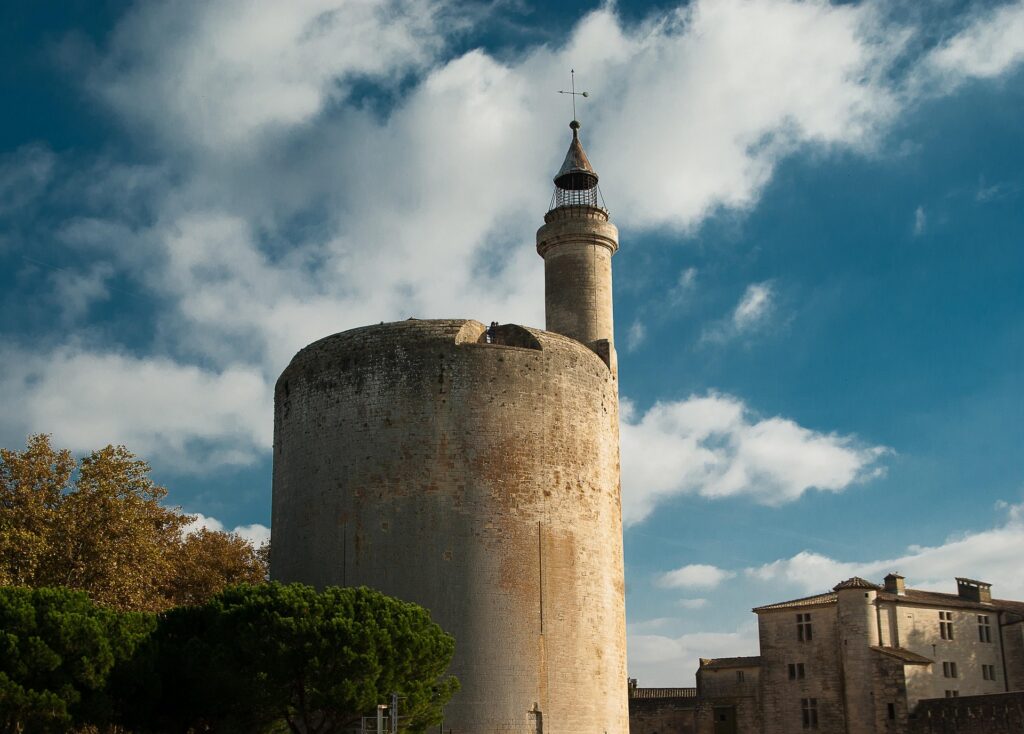
One tower stands apart from the walls, at the northwest corner. The Tower of Constance is older than the ramparts. Louis IX had it built in the 1240s to guard his new port. Its walls are 6 meters (20 feet) thick. A small turret on top served as a lighthouse. A fire burned in its iron lantern to guide ships into port.
Later, the tower found a darker use. In 1685, Louis XIV outlawed the Protestant faith in France. From the following year, Protestants who refused to convert were locked inside the Tower of Constance. Eventually, it held only women.
Marie Durand and the Word in the Stone
The most famous prisoner was Marie Durand. She entered the tower in 1730, at the age of 19. Her brother was a Protestant pastor, and she would not renounce her faith. She stayed for 38 years and was finally released in 1768.
In the upper room, one word is scratched into the stone rim of the central opening: REGISTER. It means “resist” in the local dialect. Tradition credits Marie Durand with carving it. French Protestants have never forgotten her, and visitors still climb the tower to see that word.
One word is scratched into the stone of her prison: REGISTER. Resist.
Inside the Walls: Place Saint-Louis and the Old Town
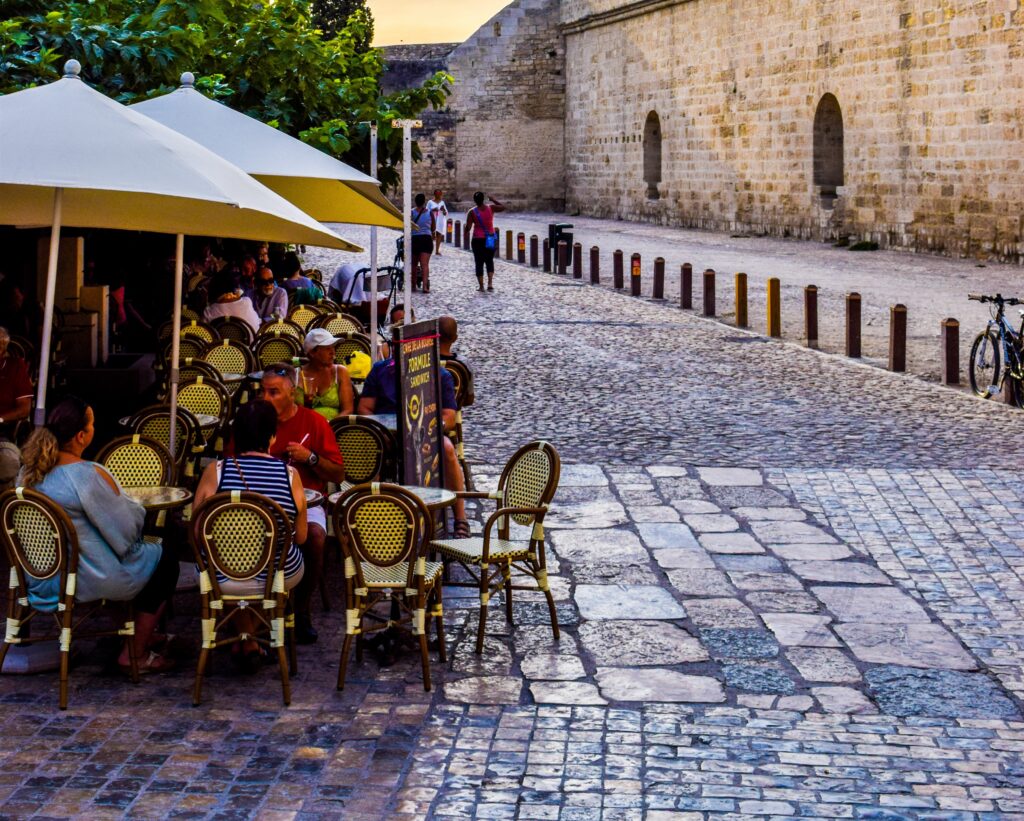
Most visitors enter through the Porte de la Gardette, the main gate on the north side. From there, the Grand Rue leads straight to Place Saint-Louis. This leafy square is the heart of town, ringed with café terraces under the plane trees.
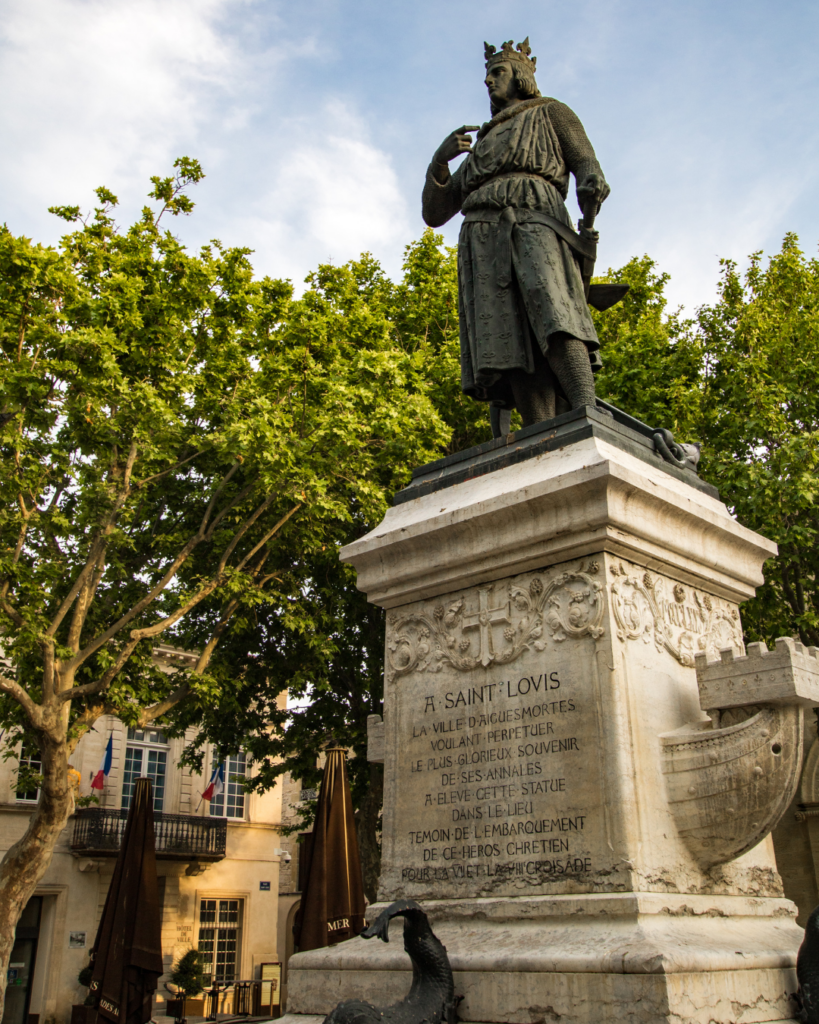
Saint Louis still presides over the town he founded. His grand bronze statue rises at the center of the square, facing the Porte de la Gardette. The sculptor James Pradier made it in 1849, a lasting reminder of the king who built Aigues-Mortes.
Just steps away is the church of Notre-Dame-des-Sablons, built in the king’s own time. A marble plaque on the church tells its proudest story. Here, Saint Louis and his knights received the cross from the Pope’s envoys before both crusades, in 1248 and 1270. Crusaders wore that cloth cross sewn onto their clothes as the sign of their vow. That is where the French word for crusader comes from: croisé means “marked with the cross.” Look for the plaque and its rallying cry, Dieu le veut (“God wills it”)
Today, the church is simple and calm inside. Modern stained glass by the artist Claude Viallat fills the old stone with bright color.
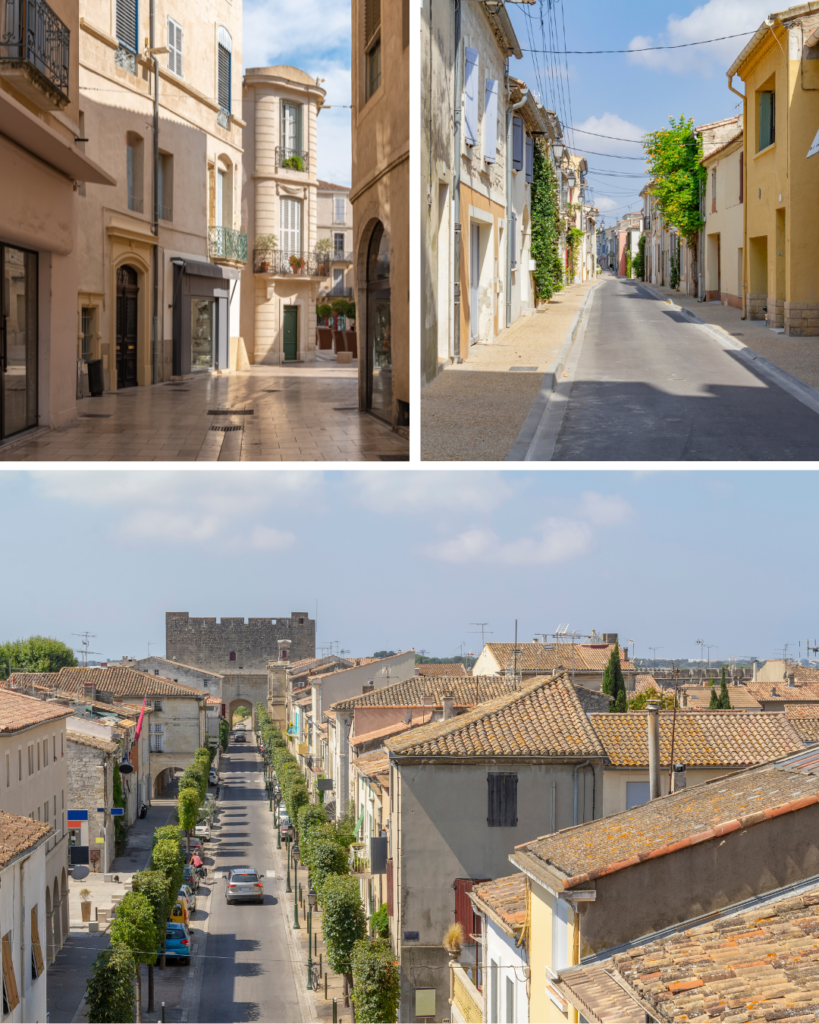
Then simply wander. The streets run in straight lines, just as the royal planners drew them. You will find art galleries, salt shops and bakeries. Every street also ends at a gate, so you cannot get lost.
Pink Salt and Flamingos: The Salt Marshes of Aigues-Mortes
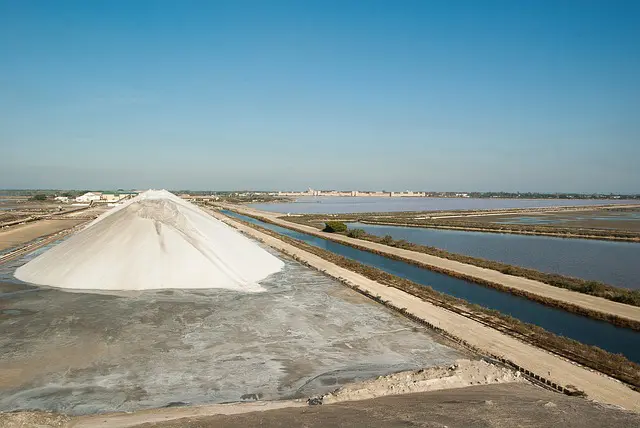
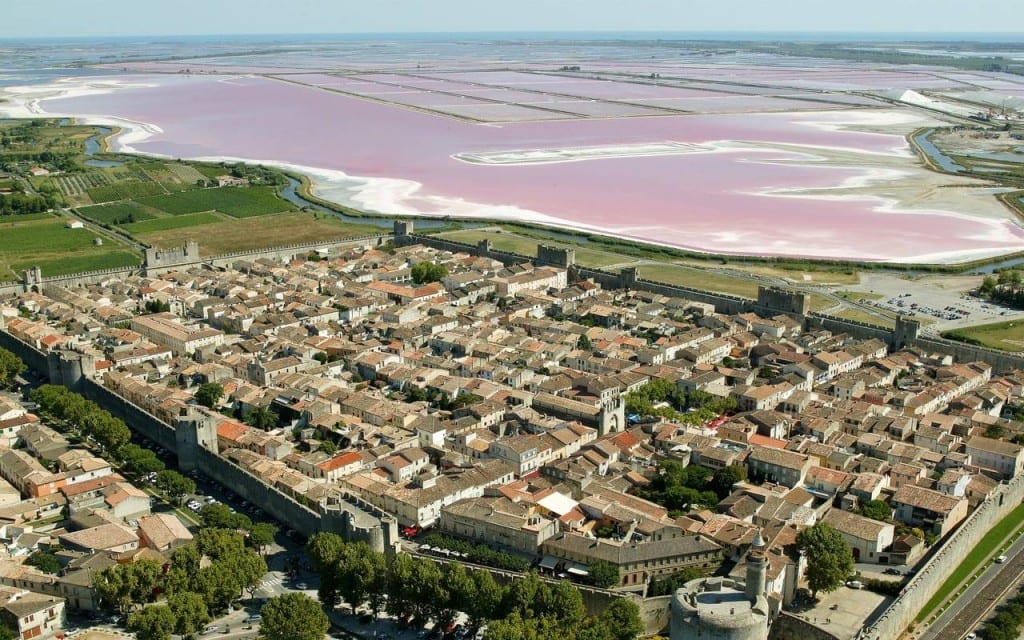
Salt was here long before the king. People have gathered it on this coast since ancient times. Today, the Salin d’Aigues-Mortes covers nearly 10,000 hectares (about 24,000 acres) at the foot of the walls. It is the largest salt works on the Mediterranean.
In summer, the shallow pools turn a startling pink. The color comes from a tiny algae that thrives in very salty water. The same pigment passes up the food chain and tints the flamingos too. Meanwhile, the harvested salt is piled into gleaming white hills called camelles.
The most prized product is fleur de sel (“flower of salt”). These delicate crystals form on the surface of the water and are skimmed off by hand. You can shop for authentic fleur de sel from Aigues-Mortes here (affiliate link). From spring to fall, a little tourist train carries visitors through the salt works in about 75 minutes.
What to Taste in Aigues-Mortes
- Fougasse d’Aigues-Mortes: Forget the savory olive bread of Provence. Here, fougasse is a soft, sweet brioche with sugar, butter and orange blossom. It was once a Christmas treat, and now the bakeries sell it all year.
- Fleur de sel de Camargue: Look for the little round tubs with a cork lid. They are light to pack and make a perfect gift.
- Vin des sables: Vines grow in the sand around Aigues-Mortes. In the 19th century, a tiny insect called phylloxera destroyed most French vineyards, yet it could not survive in sand. Today, these vineyards are known for pale, refreshing rosé.
- Gardianne de taureau: This slow-cooked bull stew is the classic dish of the Camargue. It tastes much like boeuf bourguignon and is traditionally served with local rice.
Practical Tips for Visiting Aigues-Mortes
- Getting there: Regional trains link Nîmes, Aigues-Mortes and Le Grau-du-Roi. The station is a five-minute walk from the walls.
- The old town is free: You can stroll the streets and squares at any hour. Only the ramparts and the Tower of Constance require a ticket.
- Check the closing time: The monument closes at 5:30 pm from September through April and at 7:00 pm in summer. Last entry is 45 minutes earlier.
- Bring a hat and water: The rampart walk has almost no shade. In summer, go as soon as it opens.
- Wear flat shoes: The town itself is flat and easy. However, the rampart walk has stairs and uneven stone.
- Stay for the evening: After the day visitors leave, the walls turn gold and the squares grow quiet. It is our favorite time to be there.
- See the salt marshes separately: The salt works entrance is outside the walls, on the road to Le Grau-du-Roi. Tours run in season only, so check the dates first.
Discover Aigues-Mortes With Us
Aigues-Mortes is the first stop on our 8-Day South of France Tour. On Day 1, we gather for a welcome drink at our seaside hotel in Le Grau-du-Roi. Then we drive just a few minutes to the walled city.
As evening settles in, our Tour Leader leads a short walking tour through the gates and the old streets. Afterward, we sit down together inside the walls for our Welcome Dinner. It is your first shared French meal of the journey, and a lovely way to meet your fellow travelers.
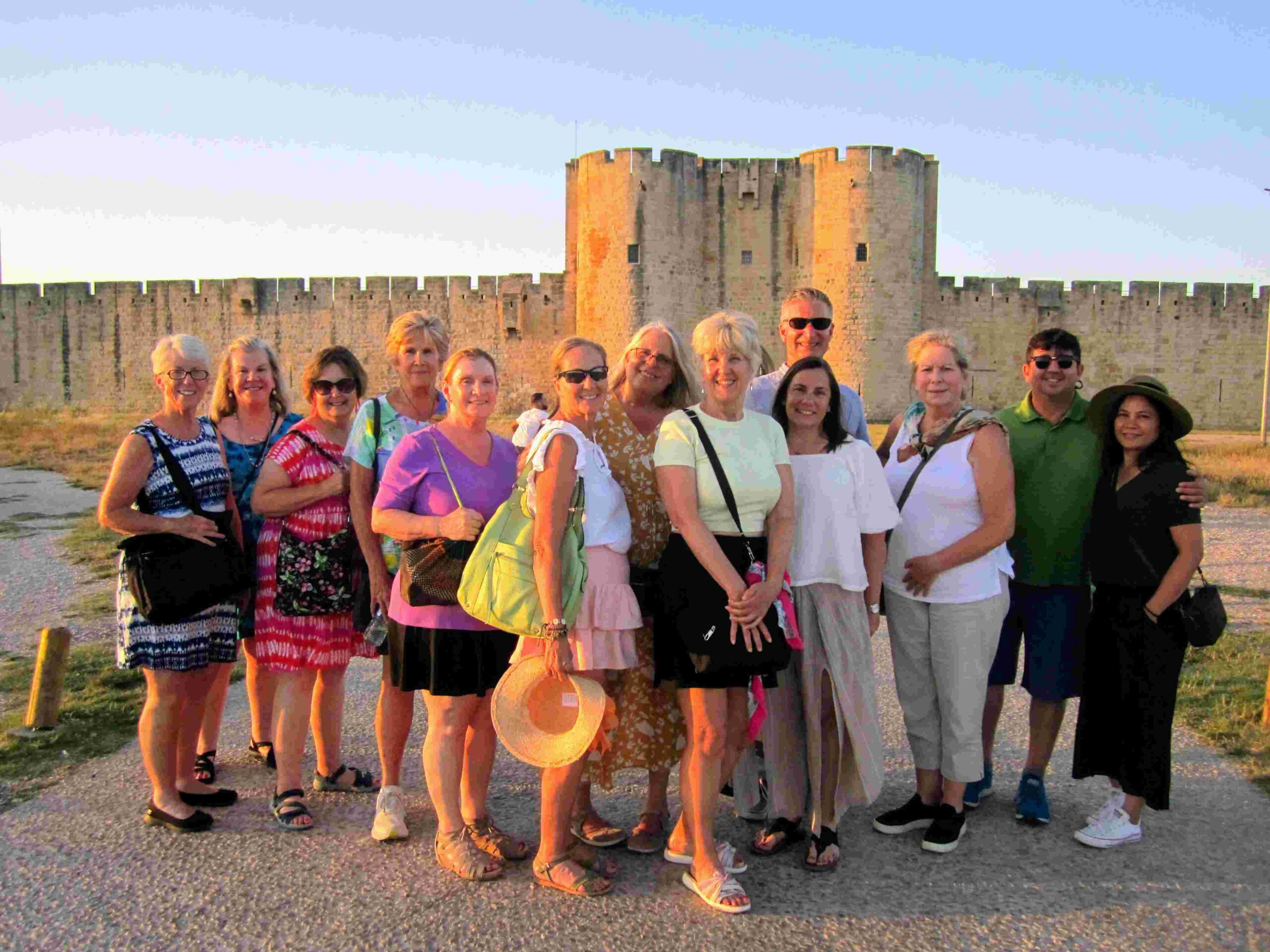
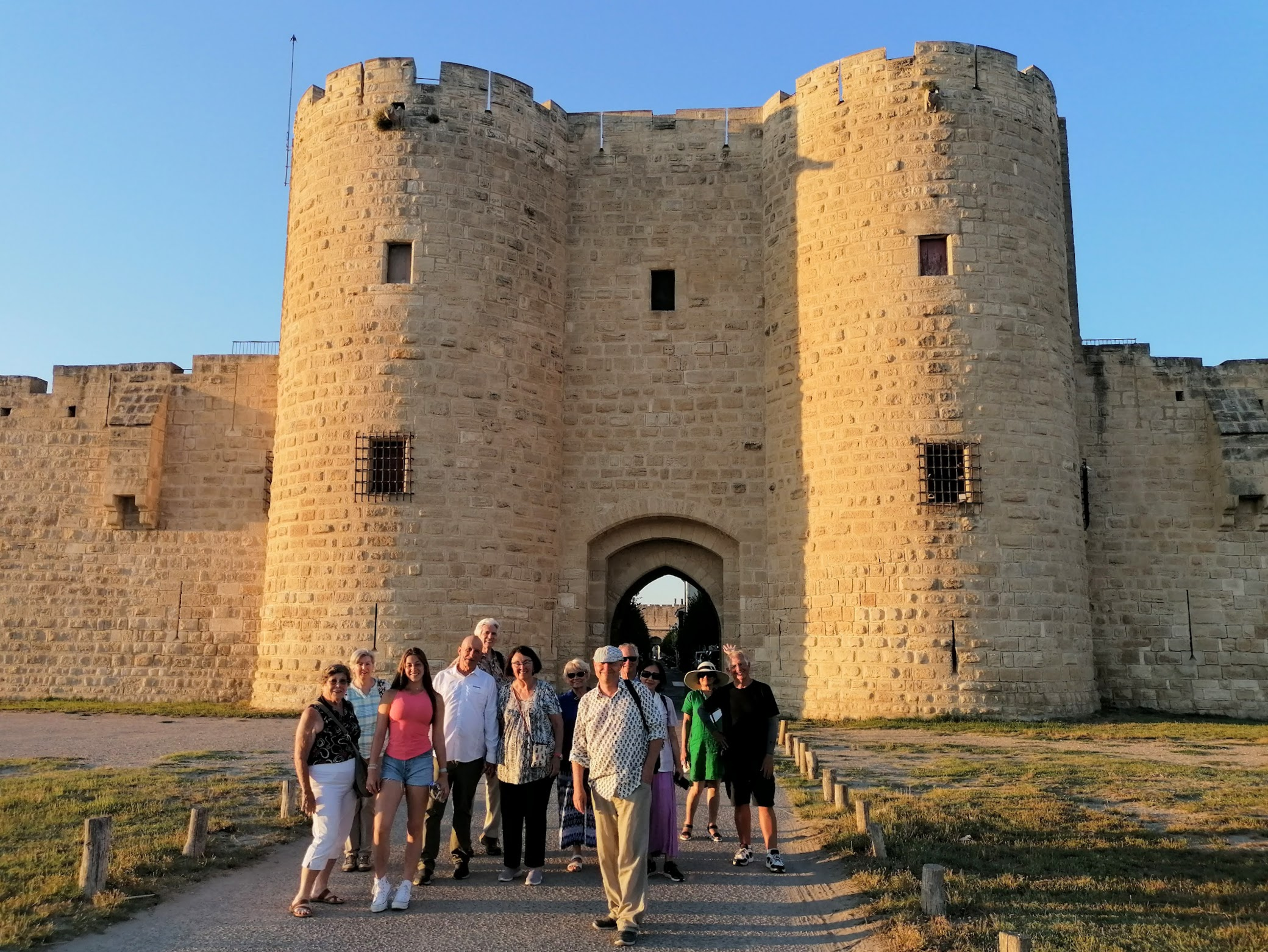
From there, the week unfolds across Provence, Languedoc and the Camargue. We visit Arles, Avignon, the Pont du Gard, Carcassonne and a working Camargue ranch. Every night, you return to the same sea-view room. With no more than 16 travelers, it is a relaxed and personal way to discover the South of France.
Explore the 8-Day South of France Tour →
Keep Reading
- Le Grau-du-Roi: A Hidden Gem on the French Mediterranean
- The Camargue: A Must-See Area of Southern France
- Captivating Carcassonne
- Vin des Sables: The Sand Wine of the Camargue
- The Pont du Gard
- South of France Map & Guide
À bientôt, mes amis
Julia